
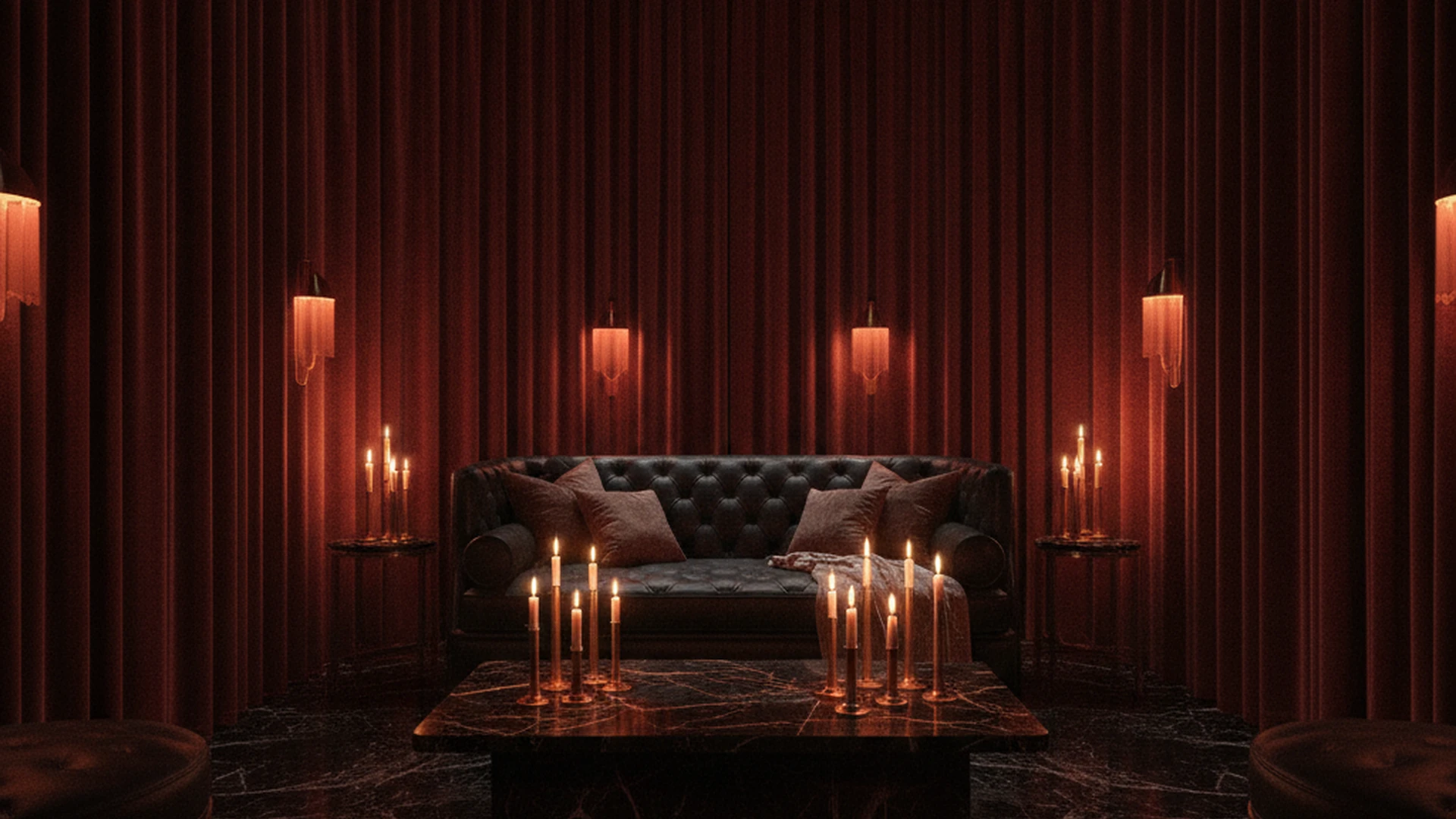
True nocturnal luxury begins long before a word is spoken or a gesture is exchanged; it begins with the deliberate calibration of space, shadow, and texture. In the modern renaissance of private pleasure culture, sensory sanctuary design has evolved far beyond improvised aesthetics into a rigorous architectural discipline. For the discerning Pleasure Dom and the aesthetically devoted couple, an intimate room is not merely a backdrop—it is an active psychological instrument that orchestrates anticipation, quiets cognitive noise, and deepens surrender.
When everyday environments are saturated with harsh overhead LED glare, digital notifications, and utilitarian surfaces, stepping across the threshold of a bespoke nocturnal sanctuary triggers an immediate neurological shift. Through the interplay of obsidian and crimson dramatic studio lighting, sound-absorbing silk and velvet drapery, and tactile material contrasts, sensory sanctuary design transforms private space into an immersive vessel of high-fashion nocturnal elegance.
The Psychology of the Threshold and Spatial Containment
As explored in The Pleasure Dom Surrender Ceremony, psychological containment is the prerequisite for uninhibited release. High-performing minds rarely relinquish control inside a cluttered or visually chaotic bedroom. Architectural containment requires establishing a distinct physical and sensory boundary between the external world of responsibility and the internal realm of desire.
In classical sensory sanctuary design, this transition is engineered through progressive compression and sensory editing. A heavy solid-core door fitted with perimeter acoustic seals eliminates ambient household noise. Inside, sightlines are intentionally curated: rather than flooding the entire room with uniform illumination, darkness is treated as the primary canvas, allowing only selected sculptural forms—a tufted black calfskin daybed, a honed Nero Marquina marble side table, or the warm glint of brushed antique brass—to emerge from the shadows.
Obsidian and Crimson dramatic studio: Mastering Nocturnal Lighting
Nothing destroys intimate atmosphere faster than high-kelvin overhead lighting. Drawing inspiration from Baroque painting and haute couture runway scenography, the foundational lighting strategy of sensory sanctuary design relies on strict dramatic studio—the dramatic juxtaposition of deep, enveloping shadow and warm, directional grazing light.
Color temperature and angle govern how the human nervous system interprets a room. As documented by architectural illumination researchers at the Lighting Research Center, ultra-warm spectrums between 1800K and 2200K—the exact chromatic range of beeswax candlelight and dimmed incandescent filaments—suppress alertness hormones while flattering skin tones and intensifying surface sheen.
- Low-Angle Perimeter Grazing: Concealed linear LED coves set to 1900K or deep crimson wavelengths positioned along floor plinths and behind drapery valances wash vertical textures upward, elongating shadows and eliminating harsh facial glare.
- Pin-Spot Focal Isolation: Narrow-beam 15-degree architectural spotlights on independent Lutron dimmers isolate the centerpiece furniture while leaving the corners of the room in velvety obsidian obscurity.
- Living Flame Reflections: Unscented pillar candles housed in smoked-glass hurricanes introduce organic micro-movement, casting flickering amber highlights across polished leather, silk restraints, and oiled hardwood.
Tactile Choreography: Silk, Velvet, Leather, and Stone
When vision is intentionally softened—or removed entirely through a silk blindfold—the skin becomes the primary organ of perception. Masterful sensory sanctuary design is therefore an exercise in thermal and tactile contrast. Every surface within reach must offer a deliberate sensory signature that rewards slow, mindful exploration.
Consider the dialogue between warm and cool materials. Honed slate, darkened steel, and cool silk charmesuse create an initial shiver of alertness against bare skin, instantly heightening nerve-ending sensitivity. Seconds later, the enveloping warmth of heavy Bordeaux silk velvet, shearling throws, or supple aniline-dyed saddle leather provides grounding reassurance. Textile historians at the Metropolitan Museum of Art Costume Institute have long observed how haute couture houses deploy weight, drape, and surface friction to command emotional presence before a garment is even touched.
In a private sanctuary, floor-to-ceiling velvet curtains serve a dual function: visually, their deep crimson and charcoal folds evoke the theatrical opulence of a subterranean Parisian salon; acoustically, their dense pile absorbs high-frequency room reflections, creating an intimate sonic dead-zone where every breath, whisper, and rustle of silk registers with hyper-real clarity.
Acoustic Intimacy and Olfactory Architecture
A truly restorative pleasure environment engages all five senses in unison. Acoustic curation within sensory sanctuary design extends beyond soundproofing to the deliberate shaping of the room’s internal resonance. By layering plush wool rugs over hardwood floors and upholstering wall panels in matte suede or heavy linen, reverberation time is reduced to a whisper-quiet standard. When low-frequency ambient soundscapes—slow sub-bass pulses, nocturnal jazz, or minimalist cello compositions—are played through concealed architectural speakers, the sound feels physical rather than directional, vibrating gently through the frame of the furniture.
Simultaneously, olfactory architecture anchors memory and ritual. Rather than overpowering the air with synthetic fragrances, a refined sanctuary utilizes cold-air nebulizing diffusers or natural resin burners infused with dark, grounding botanicals: smoked oud, labdanum, black cardamom, Madagascar vanilla bean, and aged cedarwood. Over time, this signature scent profile acts as an immediate Pavlovian cue; a single inhalation signals to the body and mind that the outside world has ceased to exist.
Bespoke Concealment and Effortless Flow
The final pillar of modern sensory sanctuary design is seamless operational choreography. Nothing interrupts the hypnotic cadence of an evening faster than searching through disorganized drawers or breaking eye contact to adjust awkward equipment. High-fashion nocturnal spaces integrate custom millwork with push-to-open obsidian lacquer cabinetry lined in charcoal Alcantara, keeping instruments, oils, linens, and glassware warmed, ordered, and silently accessible within arm’s reach.
Whether you are dedicating an entire architectural suite or transforming a master bedroom through layered drapery, dimmable dramatic studio sconces, and curated material contrasts, approaching your space through the lens of sensory sanctuary design elevates intimacy from an occasional escape into a sovereign art form. When every shadow, texture, and acoustic reflection is engineered with intention, pleasure ceases to be fleeting and becomes an enduring atmospheric state.
The Nocturnal Sanctuary Anthology: Architecture of Private Luxury
Curated in focused 900–1,200 word installments exploring tactile materiality, lighting, and atmospheric intimacy.
- Part I: Sensory Sanctuary Design: Nocturnal Luxury & Intimacy Current Installment
- Part II: Tactile Alchemy: Heavy Mulberry Silk, Obsidian Velvet & Vegetable-Tanned Leather Next Release
- Part III: Dramatic Studio Suite Lighting & Olfactory Architecture for Private Residences Upcoming
Join the Pleasuredom Inner Circle
Receive serialized 8K lookbook newsletters, private boutique drops, and discreet VIP SMS text alerts for limited footwear, lingerie, and couture releases.